

How To Repair A Bathroom Toilet
The toilet is i of the most of import fixtures in your habitation. Although toilets are sturdy and reliable components of the plumbing organization, it's a rare homeowner or apartment-dweller who never has whatever problems with a toilet. Clogging is perhaps the near mutual toilet problem, but it is far from the only one. The tank, for case, tin make all sorts of strange noises, or water tin run continuously. Fortunately, most toilet troubles can exist fixed by a practise-it-yourself plumber.
If you're a do-it-yourself kind of person, learning some quick fixes can continue you from calling the plumber. In this commodity, nosotros're going to explain various issues related to repairing toilets.
Replacing a Toilet Seat
The easiest toilet repair task is replacing the lid and seat. In that location are and so many styles of replacement seats available that you lot should have no trouble finding one to friction match any bathroom color scheme or motif. Almost modern toilets are manufactured in two standard sizes, and replacement seats are made to fit them.
One time you lot have the right size seat, remove the old ane. Remove the two nuts on the hinge and lift your old toilet seat up and out. A common problem is that the nuts securing the toilet seat may be rusted or corroded. The basics on some toilet seats are recessed and practically inaccessible, making the task fifty-fifty more difficult.
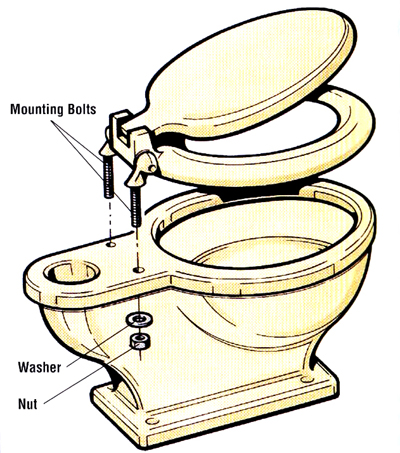
A new toilet seat can be installed by inserting the 2 bolts, slipping on the washers, and tightening the nuts. Be conscientious not to over-tighten the basics or the seat might be hard to remove after.
What's the solution? If y'all tin get to the fasteners relatively hands, apply some penetrating oil to help loosen them. Give the oil plenty of time to soak in. Use a wrench, or, if you can't reach the basics with a regular wrench, a deep socket wrench. Be certain y'all don't utilize too much force; if the wrench slips off a stubborn nut, information technology could strike and crack the tank of the bowl or anything else it happens to hit.
| Sink, Tub and Bleed Troubleshooting Guide | ||
| Trouble | Possible Cause | Solution |
| Water in tank runs constantly | Float ball or rod is misaligned. | Bend bladder rod carefully to motion ball so it will not rub against side of tank. |
| Bladder brawl contains water. | Empty or supersede bladder brawl. | |
| Float ball non rising high enough. | Carefully bend float rod down, but just slightly. | |
| Tank ball not sealing properly at bottom of tank. | Remove any corrosion from lip of valve seat. Replace tank ball if worn. Adjust elevator wire and guide. | |
| Ballcock valve does not shut off h2o. | Replace washers in ballcock assembly or, if necessary, replace unabridged assembly. | |
| Toilet does not flush or flushes inadequately | Drain is chock-full. | Remove blockage in drain. |
| Not enough water in tank. | Raise water in tank past bending bladder rod upward slightly. | |
| Tank ball falls dorsum earlier plenty h2o leaves tank. | Move guide up so tank brawl can rise higher. | |
| Leak where tank joins toilet bowl. | Tighten nuts on spud pipage; replace potato washers, if necessary. | |
| Ports around bowl rim clogged. | Ream out residuum from ports. | |
| Tank whines while filling | Ballcock valve not operating properly. | Supercede washers or install new ballcock associates |
| Waster supply is restricted. | Check shutoff to make sure information technology's completely open. Check for calibration or corrosion at entry into tank on valve. | |
| Moisture around fixture | Condensation. | Install foam liner, tank encompass, baste catcher or temperature valve. |
| Leak at flange wax seal. | Remove toilet and install new wax ring seal. | |
| Leak at bowl-tank connection. | Tighten irish potato pipe basics; replace worn spud washers, if necessary. | |
| Leak at h2o inlet connection. | Tighten locknut and coupling nut; replace washers and gasket, if necessary. | |
| Fissure in bowl or tank. | Supplant bowl, tank, or entire fixture. | |
If all else fails, y'all'll take to cut off the bolts with a hacksaw. To protect the basin'due south end, apply record to the basin at the spots the hacksaw blade is likely to rub against. Then insert the blade under the swivel, and saw through the bolts. Be extremely cautious in using the saw—a devil-may-care slip with a hacksaw tin can crevice the fixture just as hands equally a blow with a wrench.
With the nuts removed or the bolts cut, you can remove the erstwhile seat without further difficulty. Clean the area before installing the new seat. The new on can be installed by inserting the bolts and tightening the nuts. Exist careful not to over-tighten the nuts, as you may want to replace this seat someday as well. If you live in a rented apartment and install a new seat that you paid for yourself, be certain to keep the one-time 1. When you lot're set up to leave, you can replace the new on with the original and take the new seat with you lot.
If the toilet lid and seat are still in adept condition, but the small-scale rubber bumpers on the bottom are in bad shape, you tin can purchase replacement bumpers at the hardware store. Some bumpers screw in; others must be nailed or glued into place. Whichever type you have, endeavor to install the new ones in holes that are close enough to conceal the original holes.
Immigration a Chock-full Toilet
You can by and large clear a clogged toilet with a plunger, otherwise known as the plumbers' friend. Make sure that there'south enough water in the toilet basin to embrace the condom suction loving cup, then piece of work the handle of the plunger up and down. If there isn't enough h2o in the bowl, do not flush the toilet; flushing a clogged toilet volition just cause the bowl to overflow. Instead, bring a pan or pot of h2o from another source to supply the h2o you need to embrace the plunger loving cup. There are two types of plungers, and the ane with a bulb-type head is especially constructive for toilets. Some types have a fold-out head that's designed for toilet utilize.
Usually, whatever is blocking the toilet bleed is non very far away. If the plunger's action doesn't dislodge the clog, you lot can attempt to hook the blockage and pull it free. A wire coat hanger tin sometimes practice the job, but it is actually a substitute for the cupboard or toilet auger.

Before using the plunger, brand sure there'due south enough h2o in the toilet bowl to comprehend the suction cup. Pump the plunger to dislodge the clog.
The auger has a long sleeve or tube to guide the snake and auger hook into the trap. A crank on the end enables you lot to turn the hook in the drain or trap. Here'due south how to use it.
Step 1: Insert the auger into the toilet trap and turn the crank until it feels tight. This means that the serpent has twisted its way to and into the blockage.
Step ii: When you pull in the auger, you lot should be able to remove any is clogging the toilet. If you aren't successful, try the closet auger several more times. In some cases, yous may have to resort to pushing a regular plumbers' snake through the blockage.
Step 3: When all else fails, the toilet may have to be removed from the floor and turned upside downwardly so you can get a blockage. This is non what anyone would call an easy job, and then you lot should give the simpler methods every bit adept a try as you can before you lot remove the toilet. But removing the toilet is not beyond the capabilities of the average exercise-it-yourselfer, and this procedure is explained in the forthcoming section.

The closet auger has a long sleeve to guide the snake and auger hook into the trap. A creepo enables you to turn the hook and dislodge the blockage.
Toilet Tank Problems
Compared with a chock-full toilet, tank troubles tin can seem relatively insignificant. Yet strange noises or continuous water running can be more than annoying. They can also be costing you money in wasted water. Fortunately, yous can eliminate most tank troubles quickly and easily.

Toilet tank troubles are both common and annoying, and they could be costing you money in wasted water. Virtually issues, however, can exist eliminated apace and hands. This is a cantankerous section of a typical toilet tank and its components.
Once you know how the toilet works, you lot can start to look for the source of toilet tank problems. Lift the chapeau off your toilet tank, and y'all should be able to follow this procedure quite easily.
When you trip the handle on the tank to affluent a toilet, a trip lever is raised inside the tank. This lever lifts wires, which, in turn, raise the tank ball or rubber flap at the bottom of the tank. When the flush valve opening is clear, the water in the tank rushes out past the raised tank brawl and into the toilet basin below. This raises the level of h2o in the basin to a higher place the level of water in the toilet trap.
While the water is rushing out of the tank, the float brawl, which floats on tiptop of the water in the tank, drops down. This pulls downwards on the float arm, raising the valve plunger in the ballcock assembly and allowing fresh water to flow into the tank. Since water seeks its own level, the water from the tank pushes the bowl water out into the drain, causing a siphoning action that cleans everything out of the bowl. When all the water is gone from the toilet basin and air is drawn into the trap, the siphoning stops. Meanwhile, the tank ball falls back into place, closing the flush valve opening.
As the water level rises in the tank, the bladder brawl rises until the float arm is loftier enough to lower the valve plunger in the ballcock assembly and shut off the incoming water. If the water fails to shut off at that place is an overflow tube that carries excess water downwardly into the bowl to prevent the tank from inundation. If water flows continuously out of the tank to the bowl and down the drain:
Step 1: Lift up on the float arm. If the water stops, y'all know the problem is that the float ball doesn't rise far plenty to lower the valve plunger in the ballcock assembly. One reason could exist that the float ball is rubbing against the side of the tank. If this is the example, bend the float arm slightly to movement the brawl away from the tank side.

If your toilet runs continuously, check the guide and lift wire that raises and lowers the tank ball to be sure they are aligned properly.
Step 2: If the ball doesn't bear upon the tank, continue to agree the float arm and remove the brawl from the cease of the arm by turning information technology counterclockwise. Then shake the ball to see if there's h2o inside it, equally the weight of the water within could be preventing the brawl from rise normally. If there is h2o in the ball, milk shake it out and put the brawl back on the float arm. If the brawl is damaged or corroded, replace it with a new one. If there is no water in the brawl, put the ball back on and gently curve the float rod downwardly to lower the level the float ball must reach to close off the menstruum of fresh h2o into the tank.
Step 3: If the above steps don't solve the problem, check the tank brawl at the flush valve seat. Chemical rest from the h2o can prevent this brawl from seating properly, or the ball itself may have rust-covered. Water will seep through the flush valve opening into the toilet basin beneath. Turn off the water at the toilet shutoff valve and flush the toilet to empty the tank. You can now examine the tank ball for signs of clothing and examine the tank ball for signs of wear and install a new brawl if necessary. If the trouble is chemical residue on the lip of the affluent valve opening, accept some wet-dry emery cloth, steel wool, or fifty-fifty a pocketknife and make clean away the droppings.
Pace 4: If the excess water withal flows through the toilet, the guide or the elevator wire that raises and lowers the tank brawl may be out of the line or bent. Make certain the guide is in place and then that the wire is directly to a higher place the flush valve opening. Rotate the guide until the tank ball falls straight downwardly into the opening. If a elevator wire is aptitude, try to bend it back to the correct position, or install a new one. Make sure the trip lever rod is not rubbing against annihilation and the elevator wire is non installed in the wrong hole of the rod; either situation could cause the tank brawl to fall at an angle and not block the opening as information technology should.
If neither the float ball not the tank ball is at fault, and then the problem must be in the ballcock assembly.
Fixing a Toilet Ballcock Assembly
The ballcock associates looks more complicated than it really is. When you go to a hardware or plumbing-supply store to buy a new ballcock associates, y'all'll detect that both plastic and metal units are available. Plastic costs less and will not corrode. Only plastic assemblies are non as sturdy as metal ones. In addition, plastic units normally cannot be repaired because many of them are sealed. Even so, you tin can purchase a type of unit different from the one you're replacing as long as the new associates has a threaded shank the same size as the old one. If possible, bring the old assembly with you when you to buy the replacement. Here's how to prepare an older-manner ballcock assembly:
Step 1: Make sure the h2o shutoff valve for the toilet is in the OFF position.

On many older ballcock assemblies, a pair of thumbscrews holds the valve plunger. You will have to unscrew them to remove the valve.
Step 2: Remove the valve plunger, and you'll see on or ii washers or O-rings. If any of these parts is faulty, water will flow out by the plunger continuously, and the toilet will run constantly. Examine all of the washers and replace any lacking ones.
Pace three: If the ballcock assembly is sealed, supplant it every bit a unit. Shut off the toilet water supply at the shutoff valve and flush the tank. Unscrew the float arm from the onetime ballcock unit and remove the refill tube from the overflow tube.
Step iv: Expect under the tank for a coupling or slip nut where the h2o inlet piping enters the base of the tank. Loosen the coupling nut to free the water inlet pipe. Then use an adaptable wrench to grip the retaining nut or locknut immediately higher up the sip nut under the tank. Utilise another wrench to grip the base of the ballcock associates shaft inside the tank.
Step v: Unscrew the locknut under the tank to remove the ballcock assembly. If the nut is stubborn, use penetrating oil to loosen it.
Step half dozen: Life the quondam assembly out of the tank, saving the washers from all connections, both inside and exterior the tank. New ones will probably be included with the replacement unit, just proceed the old parts until you've installed the new ballcock assembly in case new parts are damaged during installation.

When installing a new ballcock assembly, make sure the gasket and the washer are properly seated and firmly secured by the retaining unit.
Step 7: Insert the new ballcock associates into the hole in the tank. With the inside washer in place, tighten the locknut on the outside sufficiently to brand the inside washer fit watertight confronting the hole, simply don't over-tighten it.
Step eight: Replace the coupling nut and water inlet pipe, reinstall the float arm, and set up the refill tube into the overflow tube.
Step nine: Plow the water back on at the toilet shutoff valve and check for leaks at all points. Of course, another thing to check is that the float ball does not rub against the dorsum of the tank.
Newer types of ballcock assemblies eliminate the float arm and the bladder ball. Ane kind features a plastic cup that floats upward to cut off the water as the tank fills. You can ready the water level in the tank past adjusting the position of the plastic cup on a pull rod. 1 advantage to this type of ballcock assembly is that it lets the water run full-force until the tank is filled. It and so shuts the water off immediately, eliminating the groaning noises some toilets make every bit a float arm gradually closes the valve.

I blazon of diaphragm-powered valve rests close to the bottom of the tank (left); it eliminates the float ball and float arm. Another type (right) uses a flapper comprehend, lifted by a chain.
Another type of ballcock also eliminates the float ball and float arm. This is a small unit that rests almost on the bottom of the tank; it'southward diaphragm-powered valve senses the level of the h2o from downward there. Moreover, since information technology requires no tools, this associates is an easy unit of measurement to install. To install these newer ballcock assemblies:
Step 1: Turn off the tank'south water supply shutoff valve. Then flush the toilet to bleed the tank. Sponge upwardly whatever water remaining in the tank before proceeding.
Pace 2: Remove the old ballcock assembly, following the process outlined above. Slip the parts over the water inlet pipe under the tank in this order: coupling nut, friction washer, cone washer, and retaining or mounting nut.
Footstep three: Install the new unit within the tank, fitting the threaded shank down through the hole over the water supply pipe and making sure the gasket fits into the hole. Start tightening the retaining or the mounting nut nether the tank onto the threaded shank: paw-tighten it merely. Push the washers into identify and manus-tighten the coupling nut under tank; be careful non to over-tighten it.
Pace 4: Inside the tank, adhere ane end of the refill tube to the tank'southward overflow pipe and place the other cease on the stalk of the replacement unit.
Footstep 5: Open the h2o supply valve to fill the tank. The h2o level in the tank tin be adjusted by a knob on the new valve unit.
Solving Common Toilet Problems
What can you do if too little h2o comes from the tank to flush the toilet basin clean?
Footstep 1: Bank check the h2o level in the tank. Information technology'southward probably likewise low. If the water level doesn't attain inside 1 ½ inches of the pinnacle of the overflow tube, bend the float arm up slightly to let more than water enter the tank.
Stride 2: If the h2o level is correct simply there's withal non enough h2o coming from the tank to clean the bowl properly, the problem may exist the tank ball on the flush valve seat the bottom of the tank. The ball is probably dropping too soon considering the guide is fix also depression. Raise the guide, but brand sure information technology stays in line with the elevator wire. If the guide and the wire are out of alignment, the tank ball volition non drop straight into the valve seat opening, and the toilet will run continuously.
Step 3: Look for other cause of inadequate flushing. The small ports around the underside of the toilet bowl's rim tin can get clogged with residue from chemicals in the h2o and foreclose a sufficient amount of tank water from running out into the bowl. A pocket-size mirror can aid you lot examine the holes, and a slice of wire coat hanger or an first Phillips screwdriver—if one is bachelor—can ream out any clogged debris.
Here'south some other common problem among toilets. Toilet tanks tin sweat and drip onto your floors just as the pipes can. There are jackets designed specifically to fit over the tank and absorb the moisture. There are also baste pans that fit under the tank to catch the dripping condensation so that information technology doesn't damage your bath flooring. A device chosen a temperator valve is another fashion to combat tank sweating. The valve provides a regulated mixture of hot and cold water, which lessens the difference betwixt the temperature inside the tank and the temperature of the surrounding air. It is this departure in temperature that causes condensation, or sweating. Consider installing a temperator valve if the water in the tank is usually below 50 degrees Fahrenheit.

The temperator valve, which requires both hot-water and cold-water supply connections, can reduce toilet tank sweating.
A temperator valve requires yous to hook upward a hot-water line to the valve, which may exist quite inconvenient if there is no such line relatively close to the toilet. Moreover, the temperator valve does non forbid the water within the tank from cooling between flushings: thus, condensation can still occur even on a temperator-equipped toilet. A leak may exist due to loose connections or lacking washers on the white potato pipe or where the h2o inlet pipe and ballcock assembly are fastened to the tank. Supervene upon any worn gaskets or washers and tighten all of the nuts, then test with bluing in the water.
Information technology is also possible that h2o is seeping out from under the toilet bowl. The wax ring seal that joins the basin to the bleed outlet may exist defective. If this is the case, the basin must exist removed, and a new gasket installed. If the leak is due to a crack in the tank or bowl, the whole toilet must be replaced.
Replacing a Toilet
Removing and replacing a toilet is not a task to be undertaken without practiced reason, merely it is certainly non beyond your capabilities. When you tin can't unclog the toilet by less drastic means, removing it is the answer. Perchance you desire a more modern toilet, maybe the bowl or the tank is cracked, or perchance the fixture leaks around its base. All of these situations phone call for removing and reinstalling the onetime toilet or installing a new fixture.
Although there'due south nothing difficult about removing and replacing a toilet, local plumbing code may prohibit anyone but a licensed plumber from doing the chore. Cheque the code for your customs to make sure it is okay for you to undertake the chore. To replace a toilet:
Footstep 1: Measure the crude-in distance—the altitude from the wall backside the bowl to the eye of the toilet floor drain. Measure out from the wall to the middle of either of the two hold-downwardly bolts, one on each side of the toilet, that concur the fixture to the floor. If there are two bolts on each side, mensurate to the center of the rear bolt.
Pace two: Select the replacement toilet unit using the rough-in distance so that it will fit properly in your bathroom. You can replace your old toilet with a more modernistic fixture, but you must make sure that the new unit will fit into the space between the drainpipe and the wall. You can install a smaller unit, but you cannot put a larger toilet into a space that was occupied past a smaller fixture.
Step three: Shut off the water supply to the toilet tank, then remove all the h2o from both the tank and the bowl. Trip the flush handle to eliminate almost of the h2o from the tank. Then soak up whatsoever water is left with a sponge. Bail out the water in the bowl with a modest container, and and then utilise a sponge to dry the bowl completely.
Step 4: If the tank is continued to the wall, remove the hanger bolts inside the tank that secure the tank to the wall. So remove the pair of bolts at the lesser of the tank that connect the tank to the basin. Remove the tank and set it out of the manner.
Step five: Remove the caps over the agree-down bolts at the base of the basin if there any. Nearly of these caps are fabricated of ceramic to match the bowl. Some types are held on past plumbers' join compound and tin can exist pried off with a putty pocketknife; others are threaded and can be unscrewed. After removing the caps, castor away the dried compound before proceeding.
Pace 6: Remove the hold-downwards basics or bolts. These may be extremely stubborn, but some penetrating oil should make removal much easier. Save the washers and bolts if you will be reinstalling the basin. In one case the concur-downwards basics or bolts are out, there's zilch else holding the bowl to the flooring. Circumspection: To prevent sewer gas from bankroll upward the bleed, you lot should plug the opening while you work. Tie a string around an old towel so information technology won't fall through the opening, and jam this plug into the bleed.
Step vii: Remove the basin. Because the bowl and the tank can crevice from just one sharp blow to the porcelain, spread out an one-time piece of carpeting on which you tin lay the fixtures. You should as well accept a saucepan and sponge handy to soak up the water you lot couldn't bond out before. With your piece of work surface prepared, rock the basin gently back and forth to loosen it, and then lift it directly up. It weights near sixty or 70 pounds. Set the bowl on the slice of rug.
Step 8: Audit the uncovered drain. If necessary, clear the drain. Once the pipe is clear, yous tin go on with the replacement of the toilet.
Step 9: Putting in a new toilet and reinstalling the one-time one are washed in the same fashion. With a putty knife, scrape away all the old putty or other sealing material from both the lesser of the basin and the flooring flange.

Typical installing of a two-piece floor-mounted toilet.

The rough-in altitude tin be measured with the toilet in place by measuring from the wall to the center of the hold-down bolt, or to the center of the rear bolt if the fixture is held by ii pairs of bolts.
Inspect the floor where the toilet was. If the floor has rotted, it will have to be rebuilt before the toilet can exist installed. Depending on how bad the damage is, the rebuilding may involve the floor, the subfloor, and even the joists. In this case, have a carpenter rebuilt the damaged area before you install the toilet. As well inspect the flange and the bolts that come up from the flange. If the flange is damaged or the bolts are stripped, replace the faulty part of parts before you get any further.
Step ten: Install a new sealer ring on the water outlet opening on the bottom of the new bowl. With the fixture upside downwards, set the sealer band into place on the bottom of the bowl. If the floor flange is recessed, yous'll need a gasket with a plastic sleeve in the band. This sleeve should face toward you as you position information technology, since information technology will become into the soil piping.
Step eleven: Apply a uniform layer of the toilet-basin setting compound nigh 2 i/8 inch thick effectually the edge of the bowl at the base. This compound is bachelor at hardware stores and plumbing-supply stores.
Step 12: Remove the plug from the bleed or soil piping. Turn the bowl right side up and place it down over the flange, guiding the bolts into place. Press downward firmly, and give the bowl a slight twist to brand sure the wax band seats properly against the flange. Place a level across the bowl to brand sure that it is level. Move the bowl equally needed to level information technology, but don't disturb or break the seal of the wax ring or the toilet will leak.
Step 13: Mitt-tighten the nuts to hold the basin to the floor. Practice not over-tighten the nuts, or else the fixture may scissure. Coat the hold-downwardly nuts and bolts with toilet bowl setting compound and reinstall the caps.
Step 14: If the tank and bowl are separate fixtures, you should at present attach the tank. Rebolt a wall-mounted tank, or reinstall the bolts and washers that connect a bowl-supported tank. Replace whatever damaged parts. If the tank and bowl are connected with tater pipage, apply piping joint compound to the threads of the irish potato slip nuts and tighten them in identify.
Step 15: Reconnect the water supply inlet pipe to the tan, brand certain the ballcock associates is properly attached, and turn the h2o back on.
Lots More Information

How To Repair A Bathroom Toilet,
Source: https://home.howstuffworks.com/home-improvement/plumbing/how-to-repair-a-toilet.htm
Posted by: reynoldscatiche.blogspot.com
0 Response to "How To Repair A Bathroom Toilet"
Post a Comment