

How To Install Brushes On Illustrator
- Illustrator User Guide
- Go to know Illustrator
- Introduction to Illustrator
- What'southward new in Illustrator
- Common questions
- Illustrator system requirements
- Illustrator for Apple silicon
- Workspace
- Workspace basics
- Create documents
- Tools
- Default keyboard shortcuts
- Customize keyboard shortcuts
- Artboards
- Customize the workspace
- Properties panel
- Set preferences
- Impact Workspace
- Microsoft Surface Dial support in Illustrator
- Recovery, undo, and automation
- Rotate view
- Rulers, grids, and guides
- Accessibility in Illustrator
- Safe Mode
- View artwork
- Employ the Touch Bar with Illustrator
- Files and templates
- Synchronize settings using Adobe Artistic Cloud
- Tools in Illustrator
- Pick
- Overview
- Selection
- Straight Selection
- Lasso
- Artboard
- Overview
- Navigation
- Overview
- Zoom
- Rotate View
- Paint
- Overview
- Gradient
- Shape Builder
- Type
- Overview
- Type
- Type on Path
- Pick
- Introduction to Illustrator
- Illustrator on the iPad
- Introduction to Illustrator on the iPad
- Illustrator on the iPad overview
- Illustrator on the iPad FAQs
- Organisation requirements | Illustrator on the iPad
- What you can or cannot do on Illustrator on the iPad
- Workspace
- Illustrator on the iPad workspace
- Affect shortcuts and gestures
- Keyboard shortcuts for Illustrator on the iPad
- Manage your app settings
- Documents
- Piece of work with documents in Illustrator on the iPad
- Import Photoshop and Fresco documents
- Select and arrange objects
- Create repeat objects
- Blend objects
- Drawing
- Draw and edit paths
- Draw and edit shapes
- Type
- Piece of work with blazon and fonts
- Create text designs forth a path
- Add your own fonts
- Work with images
- Vectorize raster images
- Color
- Apply colors and gradients
- Introduction to Illustrator on the iPad
- Cloud documents
- Basics
- Work with Illustrator cloud documents
- Share and collaborate on Illustrator deject documents
- Upgrade cloud storage for Adobe Illustrator
- Illustrator cloud documents | Mutual questions
- Troubleshooting
- Troubleshoot create or save issues for Illustrator cloud documents
- Troubleshoot Illustrator deject documents issues
- Basics
- Add and edit content
- Cartoon
- Drawing basics
- Edit paths
- Draw pixel-perfect fine art
- Draw with the Pen, Curvature, or Pencil tool
- Draw simple lines and shapes
- Paradigm Trace
- Simplify a path
- Define perspective grids
- Symbolism tools and symbol sets
- Arrange path segments
- Blueprint a blossom in five easy steps
- Perspective drawing
- Symbols
- Depict pixel-aligned paths for web workflows
- 3D effects and Adobe Substance materials
- Nigh 3D effects in Illustrator
- Create 3D graphics
- Create 3D objects
- Create 3D Text
- Nigh 3D effects in Illustrator
- Color
- Well-nigh color
- Select colors
- Use and create swatches
- Adapt colors
- Utilize the Adobe Color Themes console
- Colour groups (harmonies)
- Color Themes panel
- Recolor your artwork
- Painting
- About painting
- Paint with fills and strokes
- Live Pigment groups
- Gradients
- Brushes
- Transparency and blending modes
- Use stroke on an object
- Create and edit patterns
- Meshes
- Patterns
- Select and arrange objects
- Select objects
- Layers
- Group and expand objects
- Move, align, and distribute objects
- Stack objects
- Lock, hide, and delete objects
- Duplicate objects
- Rotate and reflect objects
- Reshape objects
- Ingather images
- Transform objects
- Combine objects
- Cutting, divide, and trim objects
- Puppet Warp
- Scale, shear, and misconstrue objects
- Blend objects
- Reshape using envelopes
- Reshape objects with effects
- Build new shapes with Shaper and Shape Builder tools
- Work with Alive Corners
- Enhanced reshape workflows with touch on support
- Edit clipping masks
- Alive shapes
- Create shapes using the Shape Builder tool
- Global editing
- Blazon
- Add together text and work with type objects
- Manage text area
- Fonts and typography
- Format type
- Import and export text
- Format paragraphs
- Special characters
- Create type on a path
- Character and paragraph styles
- Tabs
- Text and type
- Find missing fonts (Typekit workflow)
- Update text from Illustrator 10
- Standard arabic and Hebrew type
- Fonts | FAQ and troubleshooting tips
- Create 3D text effect
- Artistic typography designs
- Scale and rotate type
- Line and grapheme spacing
- Hyphenation and line breaks
- Text enhancements
- Spelling and language dictionaries
- Format Asian characters
- Composers for Asian scripts
- Create text designs with alloy objects
- Create a text poster using Epitome Trace
- Create special furnishings
- Work with effects
- Graphic styles
- Create a drop shadow
- Appearance attributes
- Create sketches and mosaics
- Drop shadows, glows, and feathering
- Summary of furnishings
- Spider web graphics
- All-time practices for creating spider web graphics
- Graphs
- SVG
- Create animations
- Slices and paradigm maps
- Cartoon
- Import, export, and save
- Import
- Import artwork files
- Import bitmap images
- Import artwork from Photoshop
- Place multiple files | Illustrator CC
- Unembed images
- Import Adobe PDF files
- Import EPS, DCS, and AutoCAD files
- Links information
- Creative Cloud Libraries in Illustrator
- Creative Cloud Libraries in Illustrator
- Save
- Save artwork
- Export
- Use Illustrator artwork in Photoshop
- Export artwork
- Collect assets and export in batches
- Package files
- Create Adobe PDF files
- Extract CSS | Illustrator CC
- Adobe PDF options
- File information and metadata
- Import
- Printing
- Prepare for press
- Set upwardly documents for printing
- Change the folio size and orientation
- Specify crop marks for trimming or aligning
- Get started with large sail
- Printing
- Overprint
- Print with color direction
- PostScript printing
- Print presets
- Printer's marks and bleeds
- Print and salvage transparent artwork
- Trapping
- Print color separations
- Print gradients, meshes, and color blends
- White Overprint
- Prepare for press
- Automate tasks
- Data merge using the Variables panel
- Automation with scripts
- Automation with actions
- Troubleshooting
- Crash issues
- Recover files later crash
- File issues
- GPU device commuter issues
- Wacom device issues
- DLL file bug
- Memory issues
- Preferences file bug
- Font issues
- Printer issues
- Share crash written report with Adobe

Did yous know y'all can use your iPad or iPhone to blueprint beautiful, high-quality brushes from photos of anything that inspires you? Relieve the brushes to your Creative Cloud Library and admission them anywhere across Photoshop and Illustrator!
Larn more about the Adobe Brush CC iPad app in this video.
Download the awesome Adobe Castor CC app from the iTunes app store.
About brushes
Brushes let you lot stylize the appearance of paths. You tin can employ castor strokes to existing paths, or you can apply the Paintbrush tool to describe a path and utilize a castor stroke simultaneously.
There are different types of brushes in Illustrator: calligraphic, scatter, fine art, pattern, and bristle. You can attain the following furnishings using these brushes:
Calligraphic brushes
Create strokes that resemble those drawn with the angled point of a calligraphic pen and are drawn along the centre of the path. When you utilise the Blob Brush tool, yous can paint with a calligraphic brush and automatically expand the brush stroke into a fill shape that merges with other filled objects of the aforementioned color that intersect or are adjacent in stacking guild.
Scatter brushes
Disperse copies of an object (such as a ladybug or a leafage) forth the path.
Fine art brushes
Stretch a brush shape (such as Rough Charcoal) or object shape evenly along the length of the path.
Bristle castor
Create brush strokes with the appearance of a natural brush with bristles.
Pattern brushes
Paint a blueprint—made of private tiles—that repeats forth the path. Blueprint brushes can include upwardly to v tiles, for the sides, inner corner, outer corner, start, and end of the pattern.

A. Calligraphic BrushB. Besprinkle BrushC. Art BrushD. Pattern CastorDue east. Bristle Castor
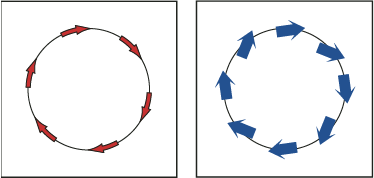
Besprinkle brushes and Pattern brushes can often achieve the same event. However, ane way in which they differ is that Design brushes follow the path exactly, while Scatter brushes practise not.
Run across a video on using brushes.
Brushes console overview
The Brushes console (Window > Brushes) displays brushes for the current file. Whenever yous select a castor in a brush library, it is automatically added to the Brushes panel. Brushes that yous create and store in the Brushes panel are associated only with the electric current file, which means that each Illustrator file tin can accept a different set of brushes in its Brushes console.
-
Choose any of the following from the panel card: Show Calligraphic Brushes, Prove Besprinkle Brushes, Bear witness Art Brushes, Show Bristle Brushes, Show Pattern Brushes.
Modify the view of brushes
-
Choose Thumbnail View or List View from the panel menu.
Change the club of brushes in the Brushes console
-
Drag a brush to a new location. Yous tin move brushes only within their type. For instance, yous cannot move a Calligraphic brush to the Scatter castor area.
Duplicate a castor in the Brushes console
-
Drag the brush onto the New Brush button
 or choose Duplicate Brush from the Brushes panel menu.
Delete the brushes from the Brushes panel
-
Select the brushes and click the Delete Brush button
 . You can select brushes that aren't used in a document by choosing Select All Unused from the Brushes panel menu.
Work with brush libraries
Brush libraries (Window > Castor Libraries > [library]) are collections of preset brushes that come with Illustrator. Y'all tin open multiple brush libraries to scan through their contents and select brushes. You tin can also open brush libraries using the Brushes panel menu.
To automatically open a brush library when you showtime Illustrator, choose Persistent from the brush library's panel bill of fare.
Copy brushes from a castor library to the Brushes panel
-
Drag the brushes to the Brushes console or choose Add To Brushes from the brush library's console carte du jour.
Import brushes into the Brushes panel from another file
-
Cull Window > Brushes Libraries > Other Library and select the file.
-
In the Brush Library console, click on the individual brush definition or all the brush definitions that you need to import and select Add together To Brushes from the Brush Library panel bill of fare (flyout menu).
Create new brush libraries
-
Add the brushes you want to the Brushes panel, and delete whatever brushes you don't want.
-
Choose Save Brush Library from the Brushes console menu, and place the new library file in one of the following folders and so that it will announced in the Brush Libraries carte du jour when you restart Illustrator:
- (Windows) User/AppData/Roaming/Adobe/Adobe Illustrator <version number> Settings/Brushes
- (Mac OS) Library/Awarding Support/Adobe/Adobe Illustrator <version number> Settings/Brushes
- Replace <version number> with the post-obit values, depending on the version of Illustrator that you take installed on your system. For more information, run acrossSupersede Illustrator version number.
If you place the file in a different binder, you tin can open the library by choosing Window > Brush Libraries > Other Library and selecting the library file.
Apply brush strokes
You tin employ brush strokes to a path created with any drawing tool, including the Pen tool, Pencil tool, or bones shape tools.
-
-
Select the path, and then select a brush in a brush library, the Brushes console, or the Command panel.
-
Drag a brush onto the path. If the path already has brush strokes practical to it, then the new brush replaces the old brush.
If you want to use a different brush to the path and desire to employ the brush stroke settings used with the original brush, agree down Alt (Win) or Choice (Mac OS) when clicking the new brush you desire to apply.
-
Draw paths and apply castor strokes simultaneously
-
Select a brush in a brush library or the Brushes console.
-
Select the Paintbrush tool
 .
. -
Position the pointer where you want the castor stroke to begin, and drag to draw a path. A dotted line follows the pointer every bit yous drag.
-
-
To draw an open path, release the mouse button when the path is the desired shape.
-
To describe a closed shape, hold downwardly Alt (Windows) or Option (Mac Bone) every bit yous drag. The Paintbrush tool displays a small-scale loop
 . Release the mouse push button (merely not the Alt or Option key) when yous are set to shut the shape.
 Illustrator sets downwards anchor points as you draw. The number of ballast points is determined by the length and complexity of the path and by the Paintbrush tolerance settings.
Tip: To arrange the shape of a brushed path afterwards you cease cartoon information technology, first select the path. Then position the Paintbrush tool on the path, and drag until the path is the desired shape. You can apply the technique to extend a brushed path as well every bit alter the shape of the path between the existing end points.
-
Double-click the Paintbrush tool to fix the post-obit options:
Fidelity
Controls how far y'all have to motility your mouse or stylus before Illustrator adds a new anchor point to the path. For example, a Fidelity value of 2.v means that tool movements of less than 2.v pixels aren't registered. Fidelity can range from 0.v to twenty pixels; the higher the value, the smoother and less circuitous the path.
Smoothness
Controls the amount of smoothing that Illustrator applies when you use the tool. Smoothness can range from 0% to 100%; the higher the pct, the smoother the path.
Fill New Brush Strokes
Applies a fill to the path. This option is most useful when drawing closed paths.
Keep Selected
Determines whether Illustrator keeps the path selected subsequently you describe information technology.
Edit Selected Paths
Determines whether yous tin modify an existing path with the Paintbrush tool.
Within: _ pixels
Determines how shut your mouse or stylus must be to an existing path to edit the path with the Paintbrush tool. This pick is just available when the Edit Selected Paths choice is selected.
Remove brush strokes
-
In the Brushes panel, choose Remove Brush Stroke from the panel menu or click the Remove Brush Stroke push
 .
. -
You lot can too remove a brush stroke past selecting the Basic brush from the Brushes panel or Control console.
Convert brush strokes to outlines
You tin can convert brush strokes into outlined paths to edit the individual components of a brushed path.
-
Cull Object > Expand Appearance.
Illustrator places the components of the expanded path in a group. Within the grouping are a path and a subgroup containing the brush stoke outlines.
Create or modify brushes
You tin can create and customize calligraphic, scatter, fine art, blueprint, and bristle brushes depending on your requirement. For scatter, art, and pattern brushes, you must first create the artwork.
Follow these guidelines when creating artwork for brushes:
-
The artwork cannot contain gradients, blends, other brush strokes, mesh objects, bitmap images, graphs, placed files, or masks.
-
For art and design brushes, the artwork cannot contain type. To reach a brush-stroke outcome with type, create an outline of the type and then create a brush with the outline.
-
For pattern brushes, create up to five pattern tiles (depending on the brush configuration), and add the tiles to the Swatches console.
Yous can make the brushes you create available for every new document by adding the brush definition to the New Document Contour. For more information on new document profiles, see Virtually new document profiles.
Create a brush
-
For besprinkle and fine art brushes, select the artwork you lot want to use. For blueprint brushes, you can select the artwork for the side tile, only it isn't necessary. For detailed guidelines to create pattern brushes, meet Guidelines for constructing design tiles. To know more about pattern brush options, see Pattern brush options.
If you do not want to see a seam betwixt the artwork pieces used to create the design brush, plow off the Anti-Aliasing option from Edit > Preferences > General (Windows) or Illustrator > General > Preferences (Mac OS).
-
Click the New Brush button
in the Brushes panel. Alternatively, drag the selected artwork to the Brushes panel. -
Select the blazon of brush you want to create, and click OK.
-
In the Castor Options dialog box, enter a name for the brush, prepare castor options, and click OK.
Modify a brush
- To alter the options for a brush, double-click the brush in the Brushes panel. Set the brush options and click OK. If the current document contains brushed paths that apply the modified brush, a message appears. Click Apply To Strokes to change pre-existing strokes. Click Leave Strokes to go out pre-existing strokes unchanged, and apply the modified brush to new strokes only.
- To alter the artwork used by a scatter, fine art, or design castor, elevate the brush into your artwork and make the changes you want. Then Alt‑drag (Windows) or Option-elevate (Mac Os) the modified brush onto the original brush in the Brushes panel.
- To modify a brushed path without updating the corresponding brush, select the path and click the Options Of Selected Object button
 in the Brushes console or select options of selected object from the Brushes panel menu (flyout menu).
Brush options
Yous can specify different options for the different types of brushes. To alter the options for a brush, double-click the brush in the Brushes console.
Scatter, Art, and Blueprint brushes all have identical options for colorization.
To customize a stroke case for Art Brushes or Pattern Brushes, click the Options of Selected Objects icon in the Brushes Panel and fix the stroke options. For fine art brush you tin can prepare the stroke width along with flipping, colorization, and overlapping options. For pattern brush, you tin can gear up the scaling options forth with flipping, fitting, and colorization options.
Calligraphic brush options
Angle
Determines the angle of rotation for the brush. Elevate the arrowhead in the preview, or enter a value in the Angle box.
Roundness
Determines roundness of the brush. Drag a black dot in the preview away from or toward the centre, or enter a value in the Roundness box. The higher the value, the greater the roundness.
Diameter
Determines the bore of the brush. Use the Diameter slider, or enter a value in the Diameter box.
The pop‑up list to the right of each option lets you lot control variations in the shape of the brush. Select one of the post-obit options:
Stock-still
Creates a castor with a fixed angle, roundness, or bore.
Random
Creates a brush with random variations in angle, roundness, or bore. Enter a value in the Variation box to specify the range within which the brush feature can vary. For example, when the Diameter value is 15 and the Variation value is five, the bore can be 10, or twenty, or whatever value in betwixt.
Pressure
Creates a brush that varies in angle, roundness, or bore based on the pressure of a drawing stylus. This option is about useful when used with Diameter. It is available only if y'all have a graphics tablet. Enter a value in the Variation box to specify how much more or less than the original value the castor characteristic will vary. For example, when the Roundness value is 75% and the Variation value is 25%, the lightest stroke is 50% and the heaviest stroke is 100%. The lighter the pressure level, the more than angular the castor stroke.
Stylus Wheel
Creates a castor that varies in diameter based on manipulation of the stylus wheel. This option is intended to be used with an airbrush pen that has a stylus wheel on its butt and with a graphics tablet that can detect that pen.
Tilt
Creates a brush that varies in angle, roundness, or diameter based on the tilt of a drawing stylus. This option is almost useful when used with Roundness. It is bachelor but if you accept a graphics tablet that tin notice how close to vertical the pen is.
Begetting
Creates a brush that varies in angle, roundness, or diameter based on the bearing of the pen. This option is most useful when used to control the angle of calligraphic brushes, especially when y'all're using the brush like a paintbrush. It is available only if you lot accept a graphics tablet that tin notice the direction in which the pen is tilted.
Rotation
Creates a brush that varies in angle, roundness, or diameter based on how the drawing stylus pen tip is rotated. This choice is virtually useful when used to control the bending of calligraphic brushes, specially when you're using the brush similar a apartment pen. Information technology is bachelor only if you take a graphics tablet that tin detect this type of rotation.
Colorization options for scatter, art, and pattern brushes
The colors that a scatter, fine art, or pattern castor paints depend on the electric current stroke colour and the colorization method of the brush. To set the colorization method, select one of the following options in the Brush Options dialog box:
None
Displays colors as they appear in the brush in the Brushes panel. Choose None to keep a brush the same colors as in the Brushes panel.
Tints
Displays the brush stroke in tints of the stroke color. Portions of the art that are black become the stroke colour, portions that aren't black become tints of the stroke colour, and white remains white. If you lot use a spot colour as the stroke, Tints generates tints of the spot color. Choose Tints for brushes that are in black and white, or when you desire to paint a castor stroke with a spot color.
Tints And Shades
Displays the brush stroke in tints and shades of the stroke color. Tints and Shades maintains blackness and white, and everything between becomes a blend from black to white through the stroke color. Because black is added y'all may non exist able to print to a single plate when using Tints and Shades with a spot color. Choose Tints and Shades for brushes that are in grayscale.
Hue Shift
Uses the key color in the brush artwork, every bit shown in the Key Color box. (By default, the key colour is the near prominent colour in the art.) Everything in the castor artwork that is the key color becomes the stroke color. Other colors in the castor artwork become colors related to the stroke color. Hue Shift maintains black, white, and gray. Cull Hue Shift for brushes that apply multiple colors. To change the key color, click the Cardinal Colour eyedropper, move the eyedropper to the preview in the dialog box, and click the colour you lot want to use as the key color. The colour in the Primal Color box changes. Click the eyedropper again to deselect it.
For information and samples about each choice, click Tips.
Scatter brush options
Size
Controls the size of the objects.
Spacing
Controls the amount of infinite betwixt objects.
Scatter
Controls how closely objects follow the path independently on each side of the path. The higher the value, the further the objects are from the path.
Rotation
Controls the bending of rotation of the objects.
Rotation Relative To
Sets the bending of rotation for scattered objects relative to the page or the path. For example, if you select Page, at 0° of rotation, objects point to the top of the folio. If you select Path, at 0° of rotation, objects are tangent to the path.
The popular‑upwards list to the right of each option lets you command variations in the shape of the castor. Select one of the following options:
Stock-still
Creates a brush with a fixed size, spacing, scattering, and rotation.
Random
Creates a brush with random variations in size, spacing, scattering, and rotation. Enter a value in the Variation box to specify the range inside which the castor characteristic tin can vary. For example, when the Diameter value is fifteen and the Variation value is 5, the diameter can be 10, or 20, or whatsoever value in between.
Pressure level
Creates a brush that varies in angle, roundness, or diameter based on the pressure of a cartoon stylus. This selection is available only if you lot have a graphics tablet. Enter a value in the rightmost box, or utilise the Maximum slider. Pressure uses the Minimum value for the lightest tablet pressure level and the Maximum value for the heaviest pressure. When you choose this setting for Diameter, the heavier the stroke, the larger the objects.
Stylus Bicycle
Creates a brush that varies in bore based on manipulation of the stylus bike. This option is available only if yous have a graphics tablet that has a stylus wheel on its barrel and tin observe input from that pen.
Tilt
Creates a brush that varies in angle, roundness, or diameter based on the tilt of a drawing stylus. It is available only if you lot have a graphics tablet that can discover how close to vertical the pen is.
Begetting
Creates a brush that varies in bending, roundness, or diameter based on the begetting of a drawing stylus. This option is near useful when used to control the bending of brushes. It is bachelor only if you have a graphics tablet that can detect the management in which the pen is tilted.
Rotation
Creates a brush that varies in angle, roundness, or diameter based on how the drawing stylus pen tip is rotated. This option is most useful when used to control the angle of brushes. Information technology is available just if you take a graphics tablet that tin can detect this type of rotation.
Art brush options
Width
Adjusts the width of the art relative to its original width. Y'all can specify the width using the Width option slider. The art brush Width pop-up menu has pen tablet options for adjusting scale variation, such as Pressure level, Stylus Wheel, Tilt, Begetting, and Rotation. The default fine art castor width is 100%.
If you apply the Width tool on a detail Art brush stroke instance, all the tablet data is converted to Width points. Notice that in the Width driblet-down list settings, the Width Points/Profiles option is selected.
Castor Scale Options
Preserves proportions in scaled fine art. The options available are: Scale Proportionately, Stretch to Fit Stroke Length, Stretch Between Guides.
Direction
Determines the management of the artwork in relation to the line. Click an arrow to prepare the management:  to identify the left side of the art is the stop of the stroke;
 to identify the correct side of the art is the cease of the stroke;
 to place the top of the art is the stop of the stroke;
 to place the bottom of the art is the end of the stroke.
Flip Along or Flip Across
Modify the orientation of the art in relation to the line.
Colorization
Pick a color for the stroke and method of colorization. You can select from different colorization methods using this drop-down list. The options are Tints, Tints and Shades, and Hue Shift.
Overlap
To avoid joins and folds of an object's edges to overlap, you tin can select the Overlap adjustment push button  .
.
Segmented art castor
Segmented fine art brush is an ability to define a non-stretchable portion at the ends of an art brush. From the Art brush's Brush Options dialog box, select the Stretch Between Guides choice, and accommodate the guides in the preview section of the dialog box.

The art enclosed between the guides is the only portion of the brush that stretches or contracts to make the art brush fit the path length.
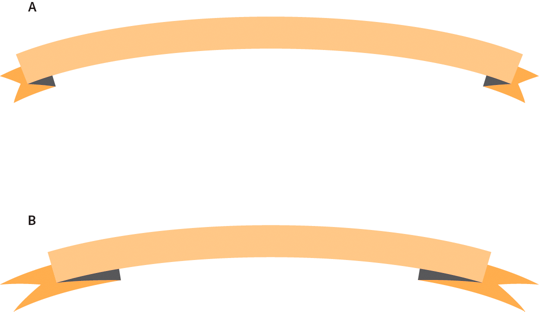
A. Segmented art brushB. Non segmented art brush
Pattern brush options
Calibration Adjusts the size of tiles relative to their original size. Specify the scale using the Scale selection slider. The Calibration drib-downwardly list for design brush tool include pen tablet options for adjusting calibration variations, such as Pressure, Stylus Bike, Tilt, Bearing, and Rotation.
If you use the Width tool on a particular Pattern brush stroke instance, all the tablet data is converted to Width points. Find that in the Scale pop-upwards carte for stroke options, the Width Points/Profiles option is selected.
Spacing Adjusts the space between tiles.
Tile ButtonsAllow you utilise different patterns to different parts of the path. Click a tile push button for the tile yous want to define, and select a blueprint swatch from the whorl listing. Repeat to apply pattern swatches to other tiles every bit needed.
You must add the pattern tiles you want to use to the Swatches panel before you fix pattern castor options. Afterwards yous create a pattern castor, yous can delete the pattern tiles from the Swatches panel if you don't plan to apply them for additional artwork.
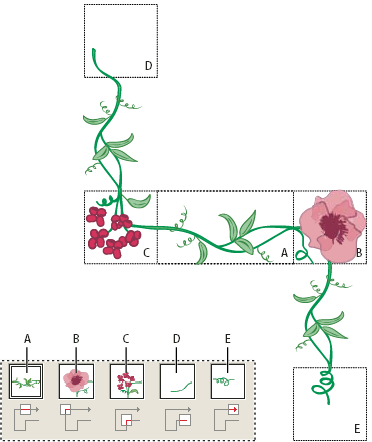
A. Side tileB. Outer Corner tileC. Inner Corner tileD. Start tileE. End tile
Flip Along or Flip Across
Changes the orientation of the pattern in relation to the line.
Fit
Determines how the pattern fits on the path: Stretch To Fit lengthens or shortens the pattern tile to fit the object. This option can result in uneven tiling. Add Space To Fit adds blank infinite betwixt each pattern tile to use the design proportionally to the path. Approximate Path fits tiles to the closest judge path without changing the tiles. This option applies the design slightly inside or outside the path, rather than centered on the path, to maintain even tiling.
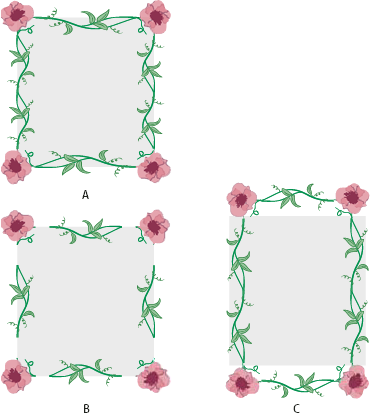
A. Stretch To FitB. Add Space To FitC. Approximate Path
Colorization
Pick a color for the stroke and method of colorization. You can select from different colorization methods using this drib-downwardly list. The options are Tints, Tints and Shades, and Hue Shift.
Bristle brush
Bristle brush allows you lot to create brush strokes with the appearance of a natural castor with beard. With Bristle castor, you tin can:
-
Create natural and fluid brush strokes that simulate the effects of painting with real brushes and media such as water colour.
-
Select brushes from a predefined library or create your own brushes from the provided tip shapes such as round, flat, or fan. You can also ready other brush characteristics such as bristle length, stiffness, and pigment opacity.
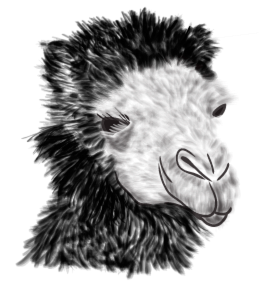
When you use Bristle brush with a graphic tablet, Illustrator interactively tracks the movements of the stylus over the tablet. It interprets all aspects of its orientation and pressure input at whatsoever point forth a cartoon path. Illustrator provides the output that is modeled on the stylus'due south x-axis position, y-axis position, force per unit area, tilt, bearing, and rotation.
A cursor annotator that simulates the tip of an bodily brush is displayed when using a tablet and stylus that support rotation. This analyst does not appear when other input devices such every bit a mouse are used. The annotator is besides disabled while using the precise cursors.
Utilise the Wacom Intuos 3 or higher tablet with Fine art (6D) pen to explore the full capabilities of the Bristle brush. Illustrator tin can translate all 6-degrees of freedom that this device combination provides. Still, other devices including the Wacom Grip pen and Art brush pen may not be able to interpret some attributes such equally rotation. These uninterpreted attributes are treated as constants in the resulting brush strokes.
While using a mouse, only ten and y-axis movements are recorded. Other inputs, such as tilt, bearing, rotation, and pressure level remain stock-still resulting in fifty-fifty and consistent strokes.
For Bristle brush strokes, feedback is displayed when you drag the tool. This feedback provides an approximate view of the final stroke.
Bristle castor strokes are made up of several overlapping, filled transparent paths. These paths, similar whatsoever other filled path in Illustrator, interact with the paint of other objects, including other bristle bush paths. However, the make full for strokes does not self-interact. Therefore, layered, private, bristle brush strokes build upwardly and interact with each other, but a unmarried stoke scrubbed back and forth in place does non interact with itself and build upwardly.
Use the Bristle castor
To use the Bristle brush do the following:
-
Create a brush definition past clicking the new castor icon or selecting New Castor from the Brushes panel bill of fare.
-
Select the Bristle Brush pick and click OK.

Bristle Brush Options dialog box -
In the Bristle Brush Options dialog box, specify:
Proper noun
of the bristle brush. Maximum length of the brush name tin can be 31 characters.
Shape
Select from ten dissimilar brush models, which provide a different cartoon experience and advent of bristle castor paths.
Size
Brush size is the bore of the castor. Like a physical media brush, the Bristle brush diameter is measured at the bespeak where the beard meet the handle (the ferrule). Specify the castor size using the slider or straight entering the size in the available text field. Range can exist between 1mm and 10mm.
Castor size from the original Brush definition is displayed in Brush preview in the Brushes panel.
The bracket keys, [ and ], are used as shortcuts for decreasing and increasing the size, respectively. The bracket keys increase and decrease the size in 1mm increments.
Bristle Length
The bristle length starts from the point where the bristles meet the handle of the bristle tip. The length of the bristles can be specified in the aforementioned mode as other bristle castor options, by dragging the Bristle Length slider, or specifying the exact value in the Bristle Length field (25% to 300%).
Bristle Density
The bristle density is the number of bristles in a specified area of the brush neck. You lot tin can set this attribute in the same style as other bristle brush options. It ranges betwixt 1% and 100%, and is calculated based on the brush size and bristle length.
Bristle Thickness
The bristle thickness can vary from fine to coarse (between one% and 100%). Set the bristle thickness like other bristle brush settings, by dragging the slider, or specifying the thickness value in the field.
Paint Opacity
This option lets you set the opacity of the paint existence used. The paint opacity can vary between one% (Translucent) and 100% (opaque). The specified opacity value is the maximum opacity used in the brush. You tin use the numeric keys[0-ix] as shortcut to prepare the opacity of bristle brush strokes where:
-
0 = 100
-
1 = 10%
-
nine = xc
In other cases, for case, if you lot enter 35 in succession, the opacity is set to 35%, and if you enter 356 in succession the opacity value is set up to 56 (last 2 digits). Whatever string of digits that ends with 00 are prepare as 100%.
Stiffness
Stiffness implies the rigidness of the bristles. If you set a depression bristle stiffness value, the bristles are flexible. They become more rigid when you set a higher value. The bristle stiffness ranges between 1% and 100%.
-
-
Click OK to create the brush definition with the called settings.
With the castor tool selected, and a Bristle brush definition called in the Brushes panel, y'all tin can create artwork using the Bristle brush.
If you try to print, save, or flatten transparency in a document with more than xxx bristle castor strokes, a warning bulletin is displayed. These warnings are displayed when you lot save, print, and flatten file content.



Source: https://helpx.adobe.com/illustrator/using/brushes.html
Posted by: reynoldscatiche.blogspot.com
0 Response to "How To Install Brushes On Illustrator"
Post a Comment